COST ESTIMATION IN PUBLIC WORKS
Have you ever wondered how the cost of a public works project is calculated, controlled, and evaluated?
Welcome to Cost Estimation in Public Works module. This course introduces you to the knowledge and practical skills required to estimate, monitor, and evaluate construction costs accurately and professionally.
You will learn how to estimate the cost of construction works, monitor project costs, and valuate construction work using appropriate quantities, rates, measurements, construction documents, and cost estimation methods while observing professional requirements.
Estimate the construction work cost
Learning Outcome 2:Monitor the project cost
Learning Outcome 3:Valuate the construction work
Images, videos, and all associated materials by the Rwanda TVET Board (RTB) are licensed under a Creative Commons Attribution, Non-Commercial, Share Alike 4.0 International License .
The author acknowledges the use of AI tools in developing these teaching materials. All AI-assisted content was carefully reviewed, adapted, and validated by the author, who takes full responsibility for the accuracy, quality, and educational suitability of the final material.
- Teacher: Jean Paul Niyonshuti

This module, PWOBC501 – Construct Bridge, is a Level 5 course worth 12 credits with a total of 120 learning hours. Learners gain practical and theoretical skills in bridge construction, covering preliminary works, substructure, superstructure, and finishing activities while applying safety and environmental standards. To successfully complete the module, students must achieve a passing line of 70% through formative and summative assessments.
- Teacher: Jean De Dieu Bazumutima
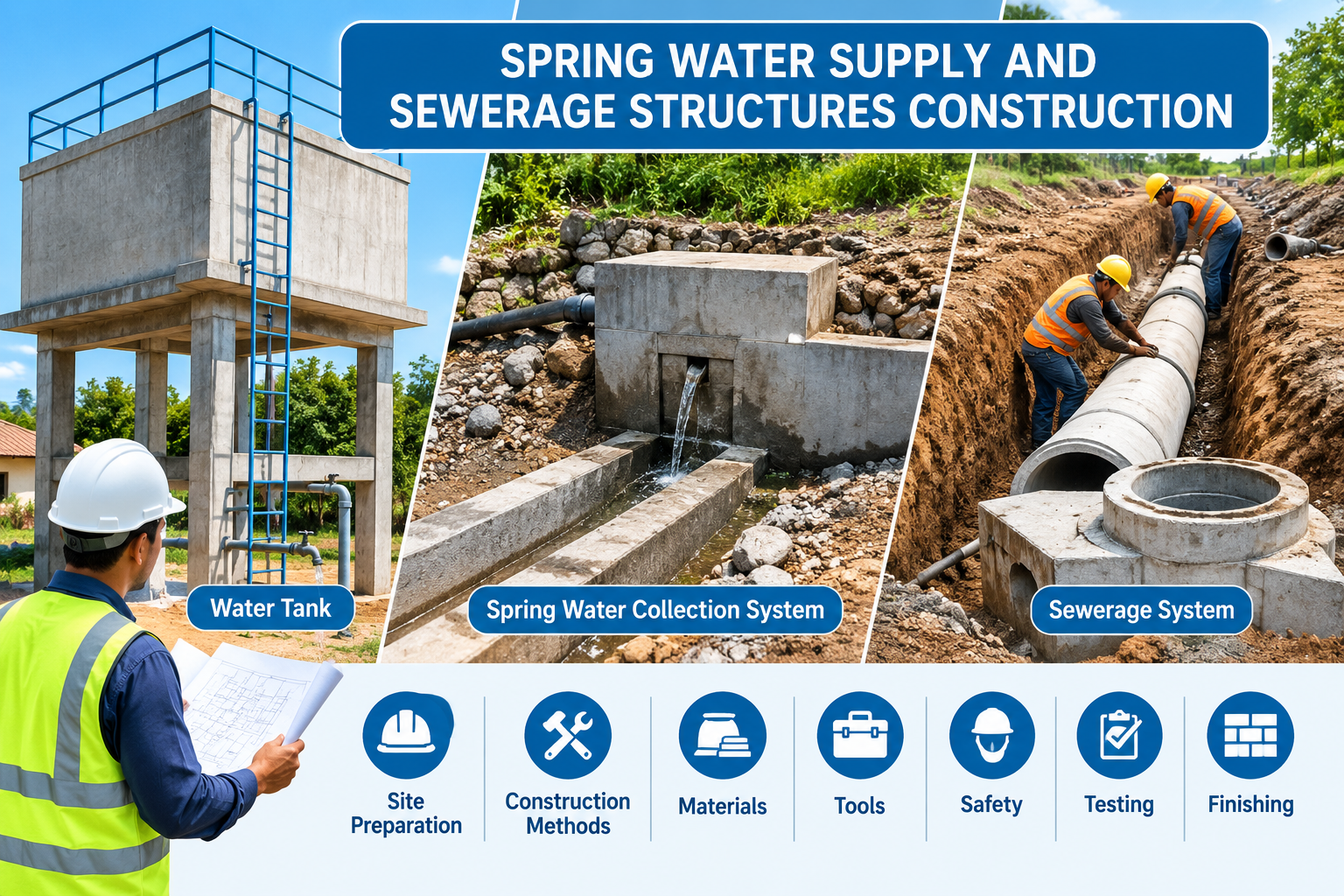
Spring Water Supply and Sewerage Structures Construction equips learners with practical skills to construct safe and functional water and sewerage structures.
The course covers water tanks, spring water collection systems, and sewerage systems, including site preparation, construction methods, materials, tools, safety, testing, and finishing.
- Teacher: Jean Paul Niyonshuti