INTRODUCTION
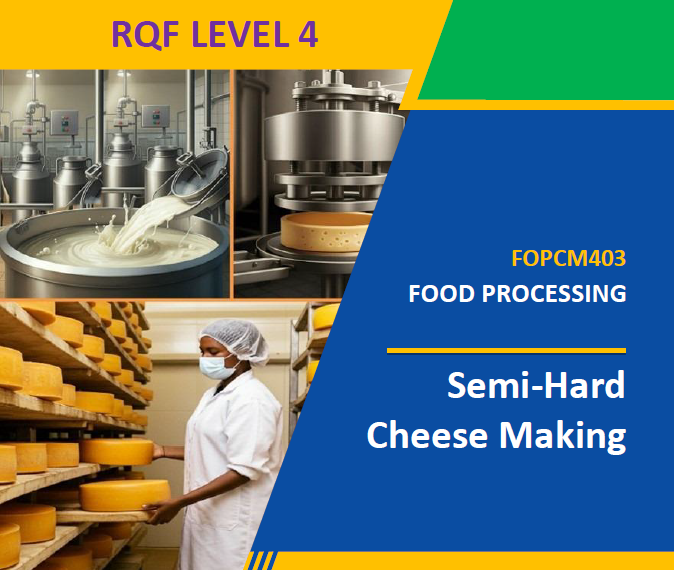
This module describes the skills, knowledge and attitude required to make semi-hard cheese in Dairy industry. It is reserved for learners pursuing Tss certificate Level IV in food processing. Upon completion of this module the learner will be able to Prepare tools, materials, equipment and work place, form curds, treat the curds and store the ripened cheese, he or she can work in semi-hard cheese making industry or other entities performing the similar activities under minimum supervision.
Semi-hard cheese making is a food-processing activity that involves transforming milk into cheese with a firm but slightly flexible texture. The process includes milk preparation, pasteurization, adding starter cultures and rennet, coagulation, cutting and cooking the curd, draining whey, pressing, salting, and ripening.
Semi-hard cheese has a moderate moisture content and a firmer texture than soft cheese. Proper processing, hygiene, temperature control, and storage are important to ensure good quality, flavour, texture, and safety of the final product.
By the end of this topic, learners should be able to:
1. Identify the tools, equipment, and materials used in semi-hard cheese making.
2. Explain the functions of different tools and equipment used in cheese production.
3. Describe the quality requirements for milk used in semi-hard cheese making.
4. Prepare the workplace and ingredients for semi-hard cheese production.
5. Explain the different stages involved in semi-hard cheese making.
6. Demonstrate milk pasteurization, starter culture addition, and coagulation.
7. Perform curd cutting, cooking, draining, pressing, and salting.
8. Apply appropriate ripening, packaging, and storage techniques.
9. Identify common defects in semi-hard cheese and their causes.
10. Apply food safety, personal hygiene, cleaning, and sanitation practices during cheese production.
- Teacher: Jean Pierre Ntezimana