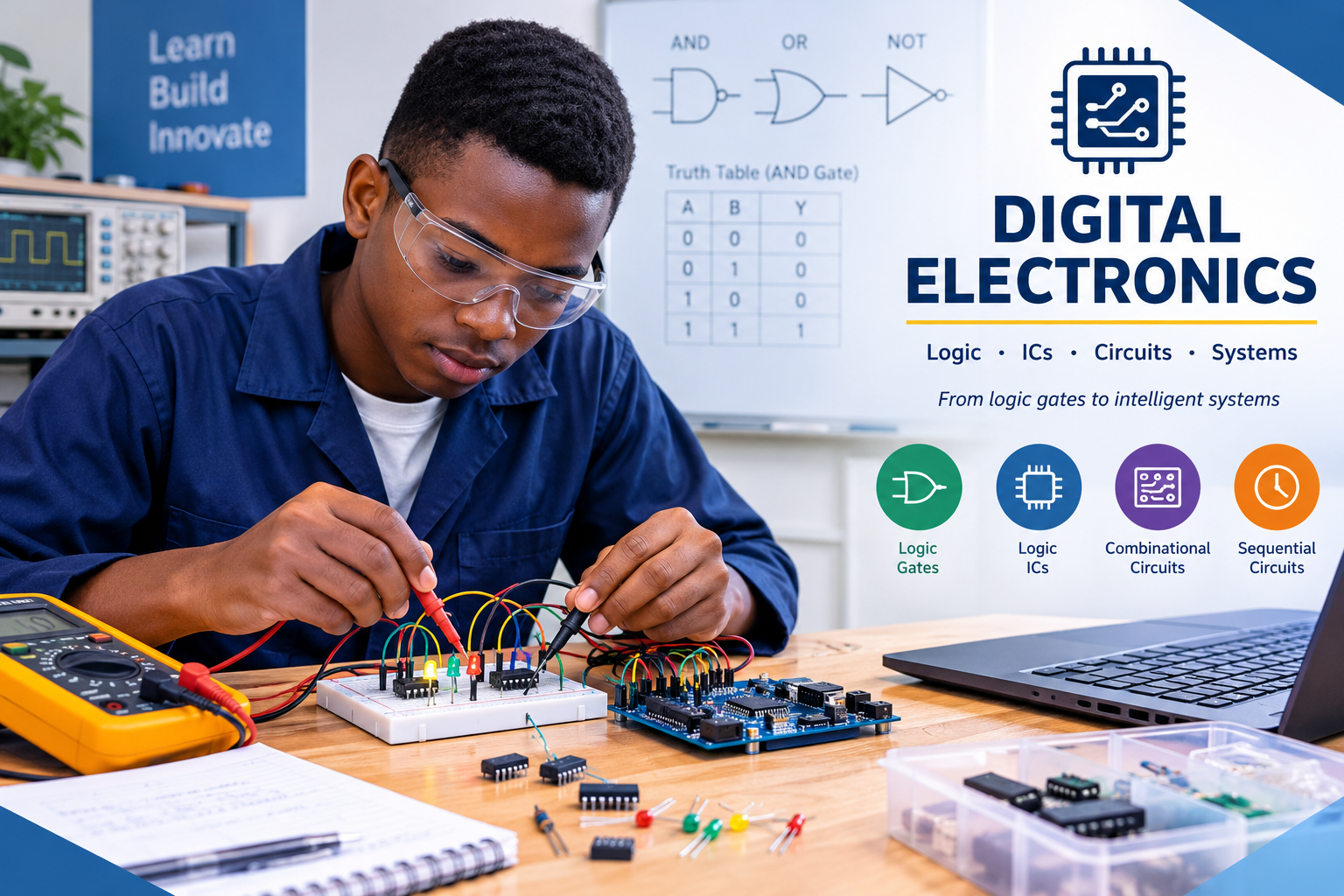
Welcome to Digital Electronics!
Have you ever wondered how a computer makes decisions, how a calculator performs calculations, or how electronic devices process digital information? This module helps you explore the digital circuits and logic systems behind these technologies through theory, circuit design, practical exercises, and troubleshooting.
Explore Your Learning Journey
Discover the four major learning areas in this module.
Apply Digital Logic
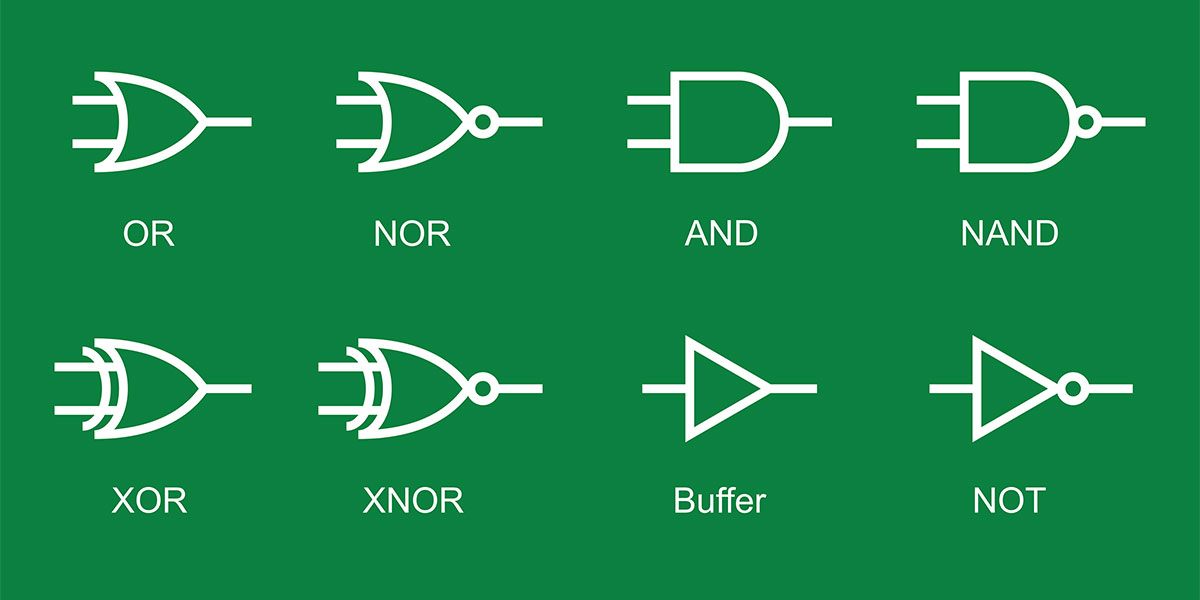
Explore binary, decimal, octal and hexadecimal number systems, digital codes, logic gates, truth tables and Boolean algebra.
Apply Logic ICs
Identify integrated circuits and investigate logic families, including CMOS, TTL and ECL, and their use in electronic circuits.
Combinational Circuits
Design and investigate adders, subtractors, multiplexers, demultiplexers, encoders, decoders and binary comparators.
Sequential Circuits
Understand latches, flip-flops, counters, registers, microprocessors and arithmetic logic units (ALUs).
How You Will Learn
Learning combines theory with practical work, helping you connect electronic concepts to real computer systems and digital devices.
Ready to Think Like an Electronics Engineer?
A digital circuit receives two inputs. Its output becomes HIGH only when both inputs are HIGH. Which logic gate does it represent?
Reveal the answer and explanation
Correct answer: AND gate
An AND gate produces HIGH (1) only when both inputs are HIGH (1). For inputs A and B, the Boolean expression is Y = A · B.
Your Digital Electronics Journey Starts Here
Be curious, practise consistently, experiment safely and challenge yourself to understand how digital systems work.
```
- Teacher: Leonard Tuyisingize