Search results: 347
- Teacher: GASPARD HARERIMANA
Preventive Maintenance (PM) Level 4 is the most advanced and comprehensive stage in a multi-tiered PM program used in manufacturing technology. This level focuses on deep inspections, diagnostics, and overhauls to ensure long-term equipment reliability and performance. It often involves specialized personnel, advanced tools, and predictive technologies.
- Teacher: AUGUSTIN MBONIGABA
This module, "Production of Soil-Based Bricks and Blocks," is designed to provide you with the practical knowledge and skills required to manufacture high-quality, durable, and sustainable soil-based building materials.
This module will guide you through the entire production process, from raw material selection to the final curing of the bricks. You will learn the scientific principles behind soil stabilization and compaction, and gain hands-on knowledge of the tools and techniques used in both manual and mechanized production.
- Teacher: Speratha MUKAMUHIRE
The course “Production of Soil-Based Bricks and Blocks” trains learners to produce soil-based bricks and blocks used in building works. It covers preparing soil, selecting suitable materials, mixing and molding, curing, and storing the products. Learners also gain practical skills in using hand tools and machines safely, ensuring quality standards, and working efficiently on construction sites. By the end of the course, trainees are able to make strong and durable bricks and blocks that can be used for walls and other building structures.
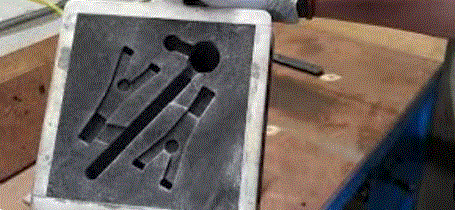
Punching is a metal cutting process used to create holes or shapes in a sheet of metal by using a punch and die. The punch presses the material into the die with high force, causing the sheared portion (slug) to separate from the sheet.
It is a fast and precise process commonly used in sheet metal fabrication to make holes, slots, or other cutouts for manufacturing parts. Punching offers high production speed, accuracy, and low cost for large-scale production.

- Teacher: NIYITEGEKA Patrick
The Quality Assurance (QA) Application Module is designed to ensure that software systems meet defined requirements, function correctly, and satisfy stakeholder expectations. It focuses on three main elements of competence, each supported by performance criteria aligned with industry standards:
1. Perform Requirements Analysis
2. Test the System
3. Generate Test Documentation
- Teacher: Josephine MUTUMYINKA

- Teacher: Jeremie NSEKAMBABAYE
Purpose statement
This module describes the knowledge, skills and attitude of quantifying various
construction works and reporting the work done. It is intended to be pursued by the
learners at TVET Certificate IV in building construction. At the end of this module, the
learner will be able to: Interpret construction drawings, determine required resources in
the construction sites, perform site data collection and reporting.
- Teacher: Jean Damascene TUYAMBAZE
This module describes the knowledge, skills and attitude of quantifying various construction works and reporting the work done. It is intended to be pursued by the learners at TVET Certificate IV in building construction. At the end of this module, the learner will be able to: Interpret construction drawings, determine required resources in the construction sites, perform site data collection and reporting.
Course Summary: Quantifying Construction Works
Quantifying Construction Works is a course designed to equip learners with the knowledge and skills necessary to measure, estimate, and value construction activities. The course focuses on the principles and techniques of taking-off quantities from drawings, preparing bills of quantities, and applying standard methods of measurement. Students will develop competencies in interpreting construction drawings, identifying work items, and performing accurate calculations for materials, labor, and costs.
The course also emphasizes the importance of accuracy, consistency, and adherence to industry standards in quantity surveying practice. It prepares learners for effective participation in cost estimation, project planning, and tendering processes in the construction industry.
By the end of the course, learners will be able to:
-
Apply standard measurement methods in quantifying construction works.
-
Take off quantities for various building and civil engineering works.
-
Prepare bills of quantities and schedules of materials.
-
Assist in cost estimation, budgeting, and tender documentation.
-
Contribute to efficient resource management in construction projects.
- Teacher: JACQUES NZAMUKWEREKA
This module describes the knowledge, skills and attitude of quantifying various construction works and reporting the work done.
It is intended to be pursued by the learners at TVET Certificate IV in building construction. At the end of this module, the learner will be able to:
Interpret construction drawings, determine required resources in the construction sites, perform site data collection and reporting.
- Teacher: Jeremie NIYONSENGA
This module focuses on the essential skills needed to measure and estimate all aspects of a building project accurately. The goal is to equip you with the knowledge to create a clear and realistic plan before any construction begins.
Here are the key topics we would explore:
Understanding a Bill of Quantities (BoQ): We'll learn how a BoQ serves as the blueprint for a project's costs and materials. It's the document that lists every item needed for the construction.
Material Estimation (Takeoffs): This section would teach you the methods for calculating the exact quantities of materials required, from the number of bricks to the amount of mortar and concrete.
Labor and Costing: You'd learn how to estimate the labor hours and skills needed for each task, and then how to translate all of these figures into an accurate total project cost.
Reporting and Documentation: Finally, we'd cover the importance of keeping detailed records and reports for project management and financial tracking.
In essence, this module is about ensuring that your project is not only well-built but also well-planned and financially sound.
- Teacher: Speratha MUKAMUHIRE
This module describes the knowledge, skills and
attitude of quantifying various construction works and reporting the work done.
It is intended to be pursued by the learners at TVET Certificate IV in building
construction. At the end of this module, the learner will be able to: Interpret
construction drawings, determine required resources in the construction sites,
perform site data collection and reporting

- Teacher: Vestine MUNKURIZE
This module describes the skills, knowledge and attitudes required for learners to be competent in Rabbit farming. At the end of this module, participants will be able to determine

This module describes the skills, knowledge and attitudes required for learners to
be competent in Rabbit farming. At the end of this module, participants will be
able to determine Construct rabbit hutches, management of production, Control
diseases and predators and record keeping

- Teacher: Illuminee BARAKAGWIRA
The course introduces the principles and practices of rabbit production, covering breeding, housing, feeding, health care, and product utilization (meat, fur, and manure). Learners gain practical skills to manage rabbit farms efficiently, improve productivity, and promote animal welfare.

- Teacher: Jean Pierre RURANGIRWA
This course provides students with the knowledge and practical skills necessary to systematically observe, record, and interpret health and production data in livestock. Accurate record-keeping is crucial for effective herd management, disease control, genetic improvement, nutrition planning, and maximizing productivity.
The course focuses on the methods, tools, and significance of recording various parameters related to animal health, reproduction, growth, and production (milk, meat, eggs, etc.). Students learn how to maintain individual and herd-level records and use data for informed decision-making.

- Teacher: ALEXIE MUMUKUNDE